Facebook & Instagram Ads Portfolio
Seven creative-led Meta Ads case studies across fragrance, fashion, beauty, education, travel, web development, and overseas-study consultancy.
Systems & Capabilities:
Complete solution
/One In-House Team / Built For Conversions
Ad spend should be accountable. Framecipher provides paid advertising services across Google, Meta, LinkedIn, TikTok, Microsoft, Amazon, and other relevant platforms, with campaigns built around leads, sales, bookings, and measurable business outcomes. We do not treat clicks, impressions, or reach as the final result. Campaign strategy, creative, landing pages, conversion tracking, and optimization are connected so you can see where your budget is going and what it is producing, for businesses in Bangladesh and international markets including the US, UK, Australia, Canada, and UAE.
Our approach
A paid campaign can generate thousands of clicks and still produce very little business value. The difference is what happens before and after the click.
Effective paid advertising starts with a clear business objective, the right audience, a relevant offer, strong creative, accurate tracking, and a conversion path that makes sense for the customer. From there, performance data guides what to test, reduce, improve, and scale.
Framecipher manages paid advertising with that full system in mind. Whether the goal is ecommerce revenue, qualified leads, booked appointments, software sign-ups, product sales, or customer acquisition, campaign decisions are tied to the outcomes that matter to your business.
The objective is not simply to spend more. It is to make each advertising decision more measurable, deliberate, and commercially useful.
Verified paid media work
Real paid campaigns with documented starting points, the work performed, and measurable outcomes tracked through platform and analytics reporting.

Seven creative-led Meta Ads case studies across fragrance, fashion, beauty, education, travel, web development, and overseas-study consultancy.
Systems & Capabilities:
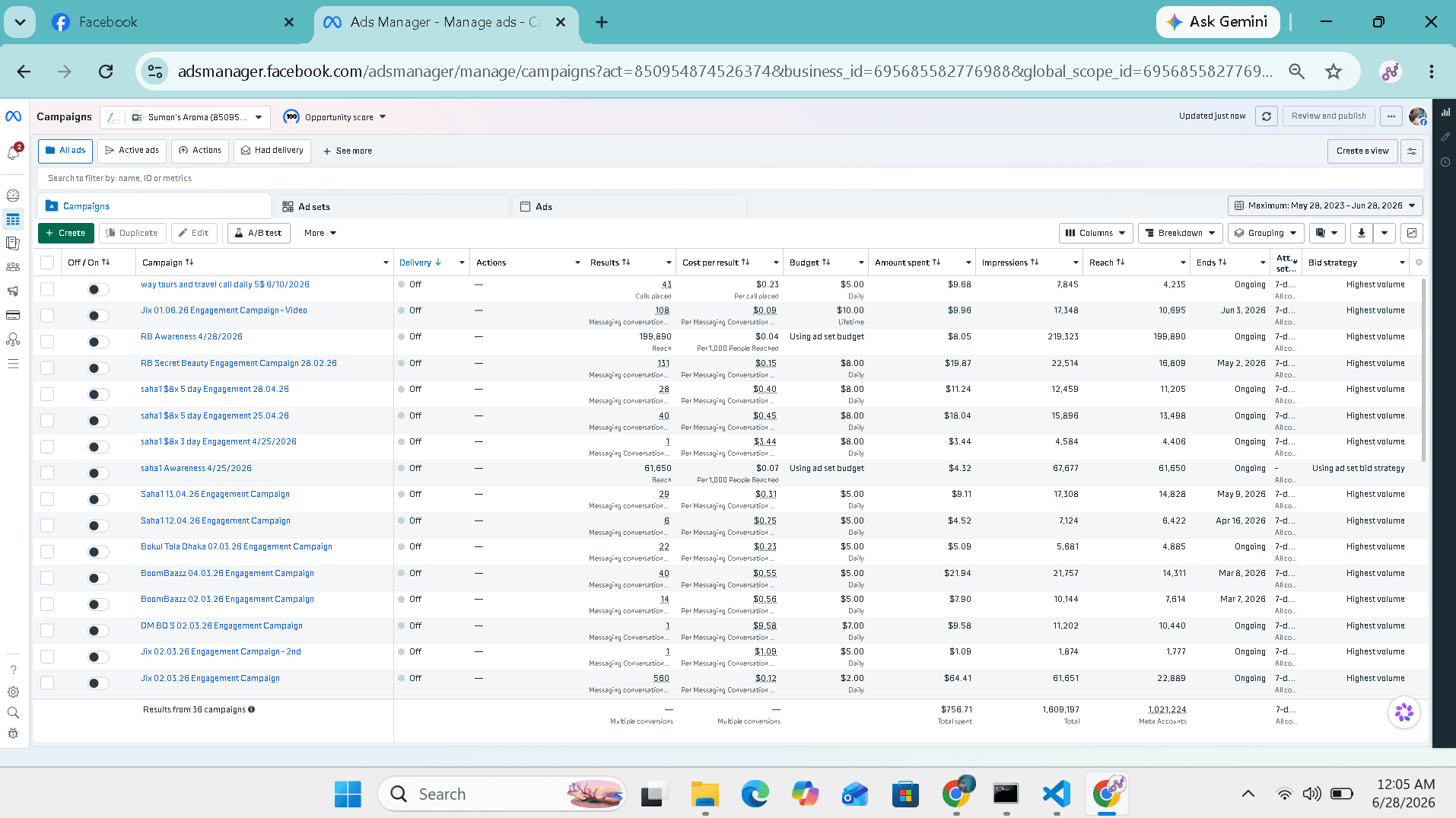
Several campaigns landed below $0.10 per messaging conversation. Across 36 campaigns, $756.71 generated 1.6 million impressions and reached over a million unique people, with blended CPM below $0.50.
Systems & Capabilities:
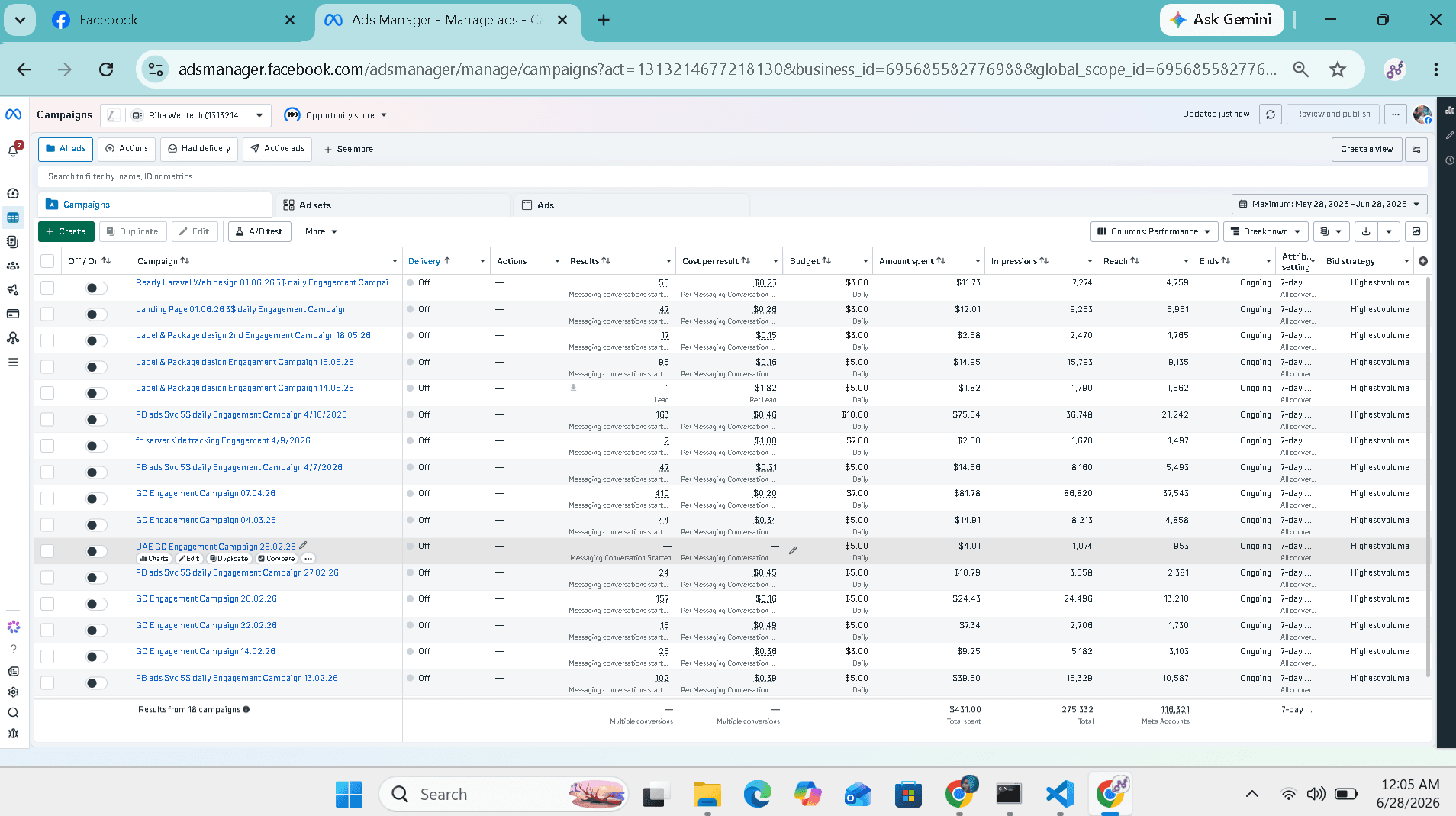
On a modest $431 spend across 18 campaigns, the account generated 275K impressions and drove messaging conversations at costs as low as $0.04; landing-page and tracking-setup campaigns settled around $0.15–$0.20 per conversation.
Systems & Capabilities:
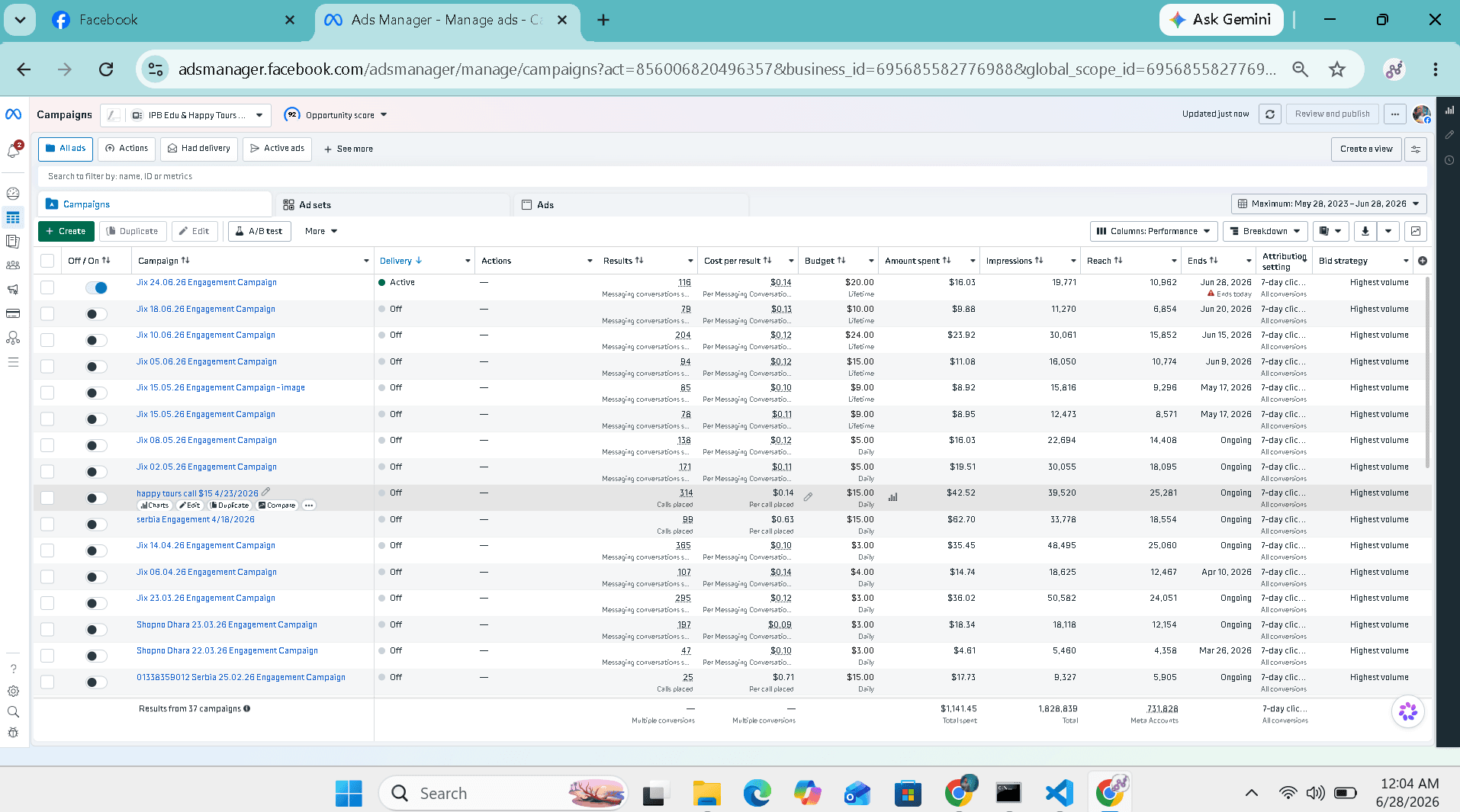
Cost per messaging conversation frequently landed between $0.09 and $0.15. One May campaign produced more than 30,000 impressions from a $5 daily budget. Across 37 campaigns, $1,141.45 produced 1.83 million impressions.
Systems & Capabilities:
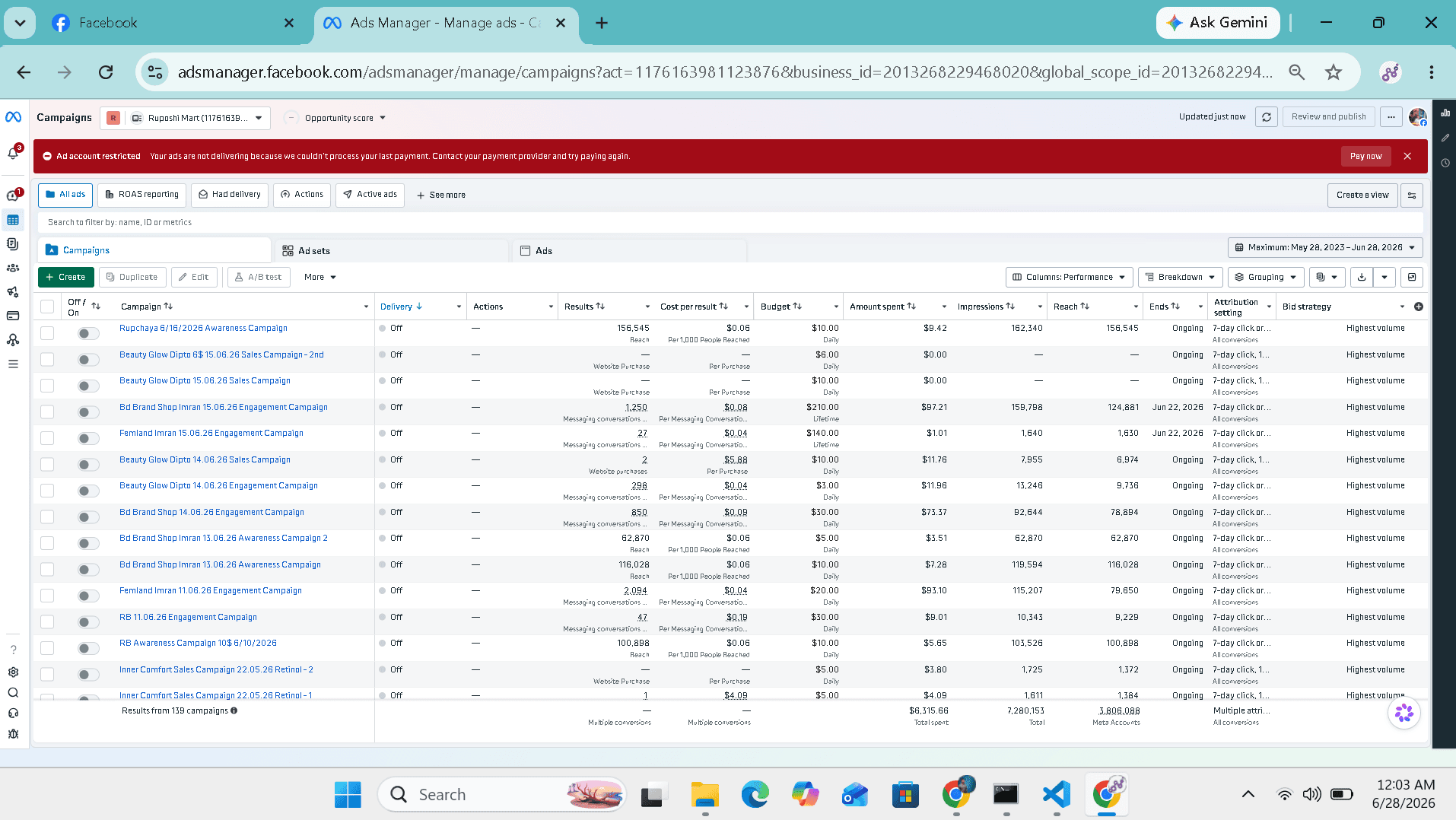
A $10-per-day awareness campaign for Rupchaya reached 156,545 people. Across 138 campaigns, $6,315.66 produced 7.28 million impressions and reached 1.8 million people, with low frequency across most awareness activity.
Systems & Capabilities:
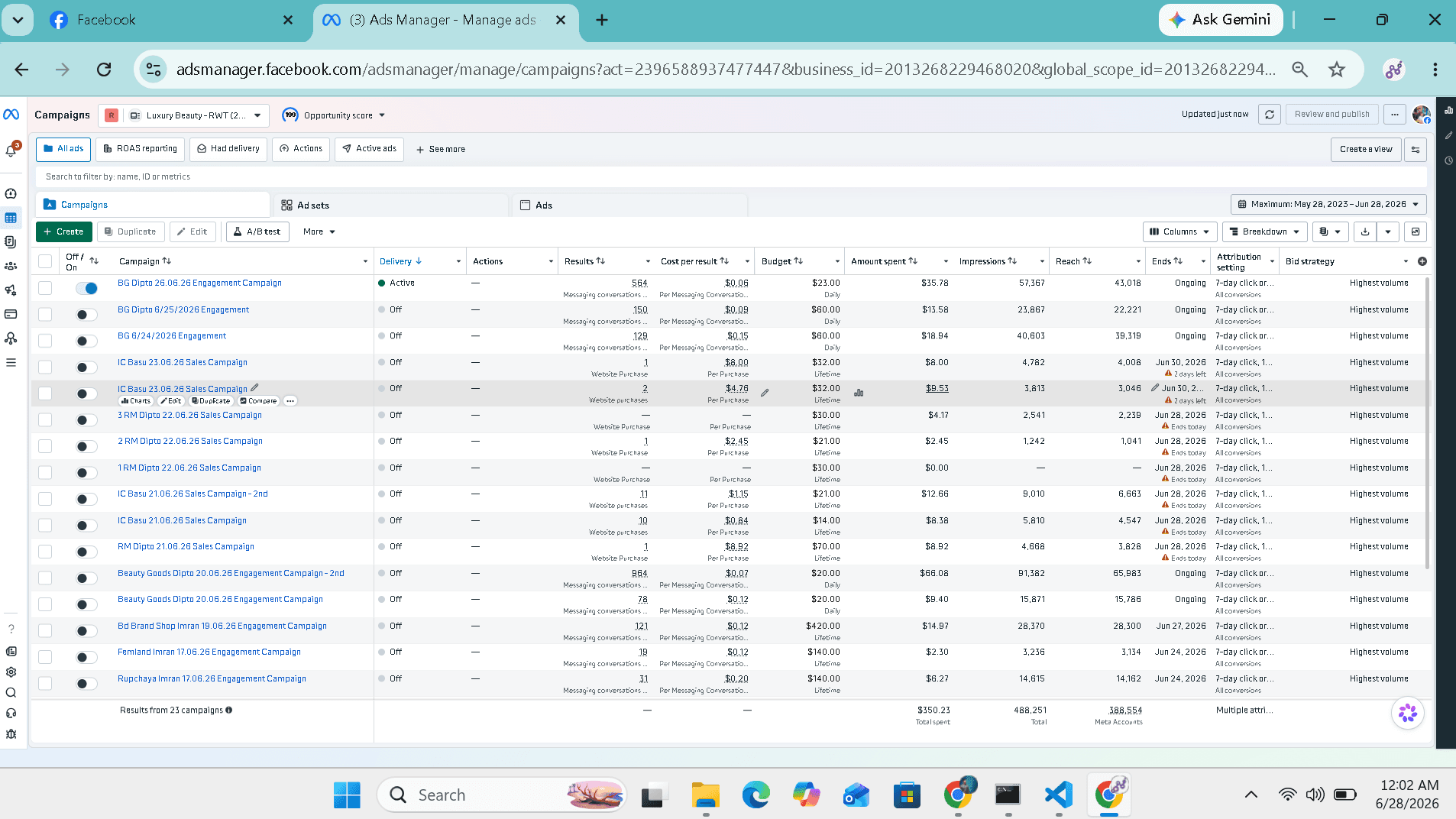
On $350.23 in spend, the account reached 388,554 people with 488,251 impressions, while purchase-optimized campaigns held cost per purchase in the low single digits.
Systems & Capabilities:
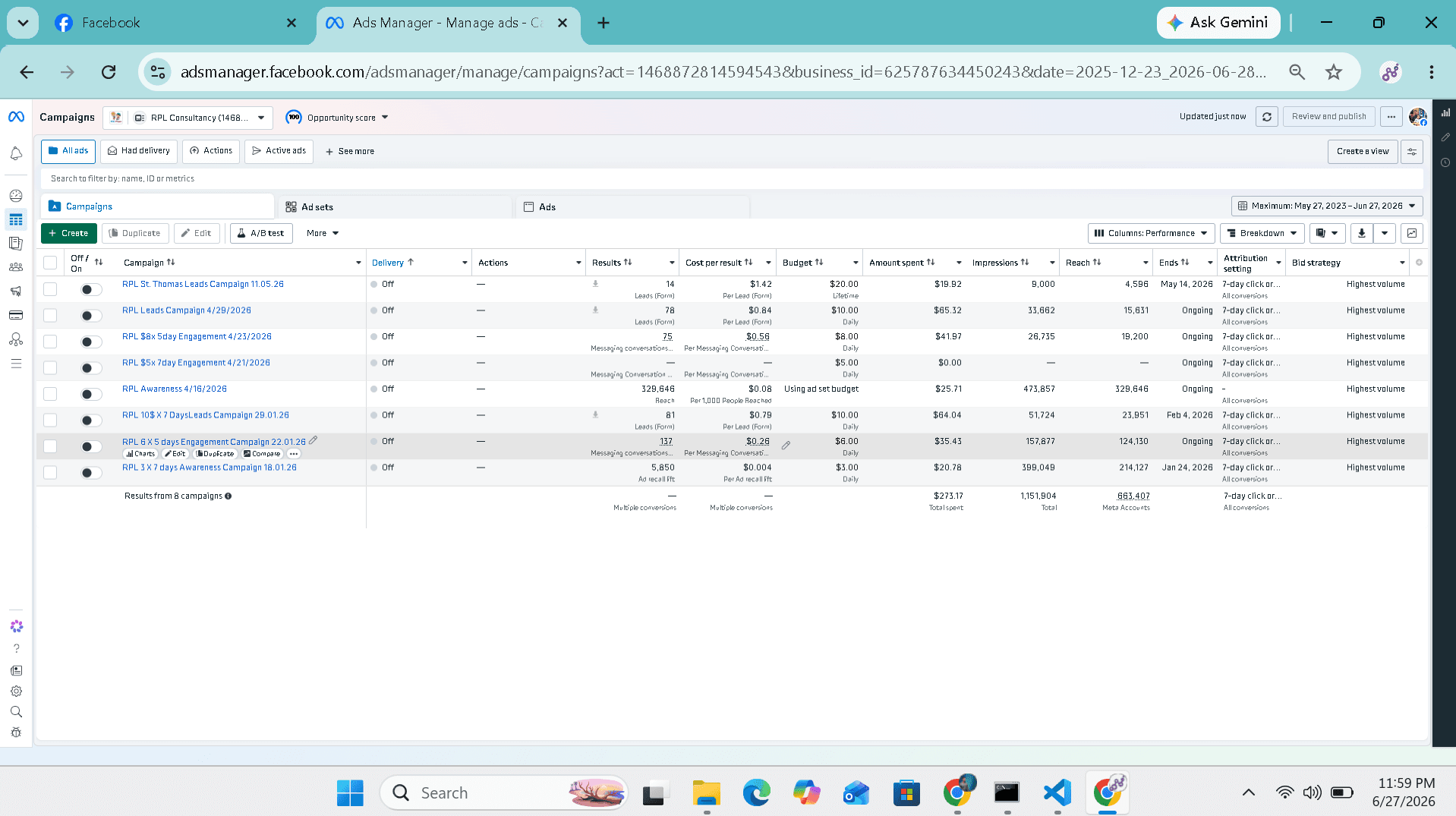
The lead-form campaign converted at $1.42 per lead, the awareness campaign reached 329,646 people using ad-set budget optimization, and ThruPlay views cost fractions of a cent. Eight campaigns generated 1.15 million impressions and reached 663,407 people from $273.17.
Systems & Capabilities:

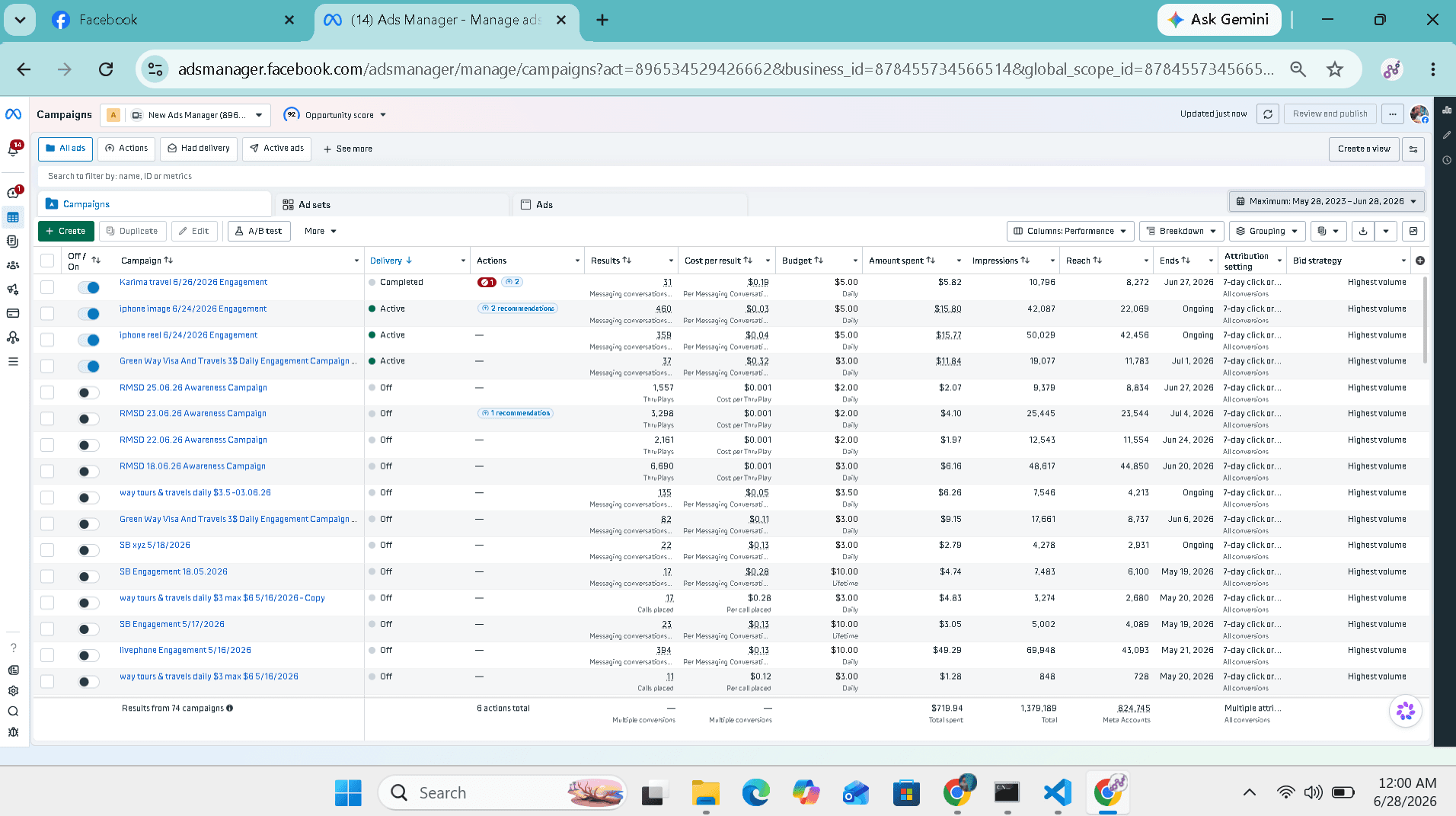
Travel messaging campaigns held costs between $0.03 and $0.32. RMSD ThruPlay campaigns ran at roughly $0.001 per view. Across 74 campaigns, $719.94 generated 1.38 million impressions and reached 824,745 people.
Systems & Capabilities:
Each case study explains the starting situation, the campaign structure, the optimization decisions, and the measurable outcome reported through platform and analytics data.
Explore the services
Start with the focused capability that matches your immediate goal, or combine several services into one coordinated engagement.
Capabilities & Scope
Paid advertising involves much more than creating ads and pressing launch. We manage the strategy, campaign structure, creative coordination, tracking, landing-page alignment, optimization, and reporting required to turn media spend into measurable business results.
We build a paid media strategy around your business model, customers, sales cycle, offer, market, and budget.
The strategy determines which platforms deserve investment, which audiences to prioritize, what funnel stages need support, and how the budget should be distributed.
For some businesses, that may mean capturing existing search demand. For others, it may require social discovery, lead generation, remarketing, marketplace advertising, or a combination of channels.
The right audience is more important than simply reaching a large audience.
We examine who is most likely to buy, what they are searching for or responding to, what problems they are trying to solve, what objections may prevent conversion, and where they are in the buying journey.
Campaign structure affects how clearly your budget, targeting, creative, and performance can be evaluated.
We organize accounts around meaningful business objectives and measurable campaign groups, with the right settings, targeting, budgets, bidding approach, audiences, exclusions, and conversion actions for each campaign.
A strong campaign can still struggle when the creative does not communicate the right message.
We develop and coordinate ad concepts around the audience, offer, funnel stage, and platform context.
You cannot optimize what you cannot measure reliably.
We establish the conversion events needed to understand what paid traffic actually produces, subject to the available website, analytics, CRM, and platform setup.
The ad is only one part of the conversion path.
A relevant click can still fail because of a slow page, weak offer, poor message alignment, confusing navigation, weak trust signals, or unnecessary friction during the conversion process.
We review the relationship between: Ad → Landing Page → Offer → Form or Checkout → Conversion.
Not every visitor is ready to convert on the first visit.
Remarketing helps reconnect with people who have already interacted with your website, products, ads, or other relevant touchpoints. We can build remarketing strategies around different stages of intent.
Reporting should lead to decisions, not simply display numbers.
We monitor the metrics that matter for the campaign objective and use performance data to determine what should be changed next.
The post-click experience
Paid advertising does not end when someone clicks. The quality of the landing page, offer, and conversion path determines whether the click produces business value.
The message that earns the click should be the message the page continues. We review whether the landing page delivers the promise the ad made and gives the visitor a clear next step.
This is where a large share of paid campaign spend is wasted. The click is earned and then lost in the post-click experience.
A relevant click can still fail because of a weak offer, too much form friction, unclear pricing, missing trust signals, or a conversion path that does not match the customer’s readiness.
We identify the specific barriers between the click and the action your campaign was built to produce.
Common limitations
A campaign can fail for reasons that have little to do with the advertising platform itself. We look beyond the ad account to identify where the actual problem is.
If conversions are not measured correctly, optimization decisions may be based on incomplete or misleading data. A campaign may appear profitable when it is not, or weak when the platform is simply failing to capture the real outcome.
Even strong creative cannot compensate for targeting the wrong people. Campaigns can underperform when the audience is too broad, too narrow, poorly matched to the offer, or disconnected from the actual buying intent.
An ad can generate attention without creating enough reason to act. Price, positioning, trust, urgency, product-market fit, guarantees, incentives, or the clarity of the offer can all affect conversion.
Repeated, generic, or poorly matched creative can limit performance. Strong paid advertising often requires multiple angles, formats, messages, and creative variations so the campaign can learn what actually resonates.
The ad can do its job and still lose the customer after the click. Common problems include slow page experience, message mismatch, weak calls to action, unclear value proposition, poor mobile usability, too much friction, weak trust signals, and complicated forms or checkout.
Running Google, Meta, TikTok, LinkedIn, and other platforms independently can make the overall strategy harder to control. Each channel should have a defined role within the customer journey rather than receiving budget simply because it is available.
Campaigns cannot improve consistently without structured testing. We look for opportunities to test audiences, creative, offers, landing pages, campaign structures, and budget allocation based on measurable hypotheses rather than random changes.
Scope & Deliverables
Every paid advertising engagement is different. The actual scope depends on your platform mix, number of campaigns, creative requirements, tracking needs, landing-page work, and market coverage.
A paid media plan built around your business model, customers, markets, goals, budget, and conversion economics.
Campaign setup, structure, targeting, budgeting, optimization, and ongoing account management based on the agreed scope.
Ad concepts, messaging, creative coordination, and structured testing designed around platform context and audience behavior.
Conversion measurement configured around the actions that matter to your business, with reporting designed to connect advertising activity to actual outcomes.
Review and coordination between the ad, offer, landing page, form, checkout, or other conversion path so post-click performance is not ignored.
Regular performance reporting that explains what your advertising produced, what changed, what needs attention, and where the next opportunity lies.
We define the final scope after reviewing your account and goals so you pay for work that aligns with your actual paid advertising needs.
Who we help
Paid advertising can serve very different business models. Campaign strategy should reflect those differences.
For ecommerce businesses, we focus on product discovery, purchase intent, shopping campaigns, catalog or product advertising, remarketing, creative testing, and conversion efficiency. Campaign decisions are connected to product value, margins, average order value, and customer acquisition economics.
For service businesses and other lead-driven companies, the goal is not to collect as many forms as possible. We focus on generating relevant inquiries that match the business's actual service area, customer profile, offer, and sales process.
Where possible, lead quality should feed back into campaign optimization rather than stopping measurement at the form submission.
B2B campaigns often require more deliberate audience selection, stronger educational messaging, longer consideration periods, and more careful lead evaluation. We can structure campaigns around decision-makers, industries, account characteristics, search intent, and different stages of the buying journey.
Local businesses can use paid advertising to generate calls, bookings, inquiries, store visits, service requests, and local product demand. Campaigns can be structured around relevant locations, service areas, local intent, and the actions that matter most to the business.
SaaS and technology companies often need to balance acquisition cost against trial quality, activation, retention, and customer value. Paid campaigns can support product discovery, demo requests, trials, sign-ups, remarketing, and targeted acquisition while measurement is connected to the actual customer journey.
Startups often need to learn quickly which audiences, offers, channels, and messages can produce viable customer acquisition. We use testing and measurement to identify what deserves additional budget rather than assuming scale should come first.
Larger businesses may need multi-platform, multi-market, multi-product, or multi-team campaign management. We can structure paid media around different business units, markets, audience segments, and conversion objectives while keeping reporting and budget visibility centralized.
Channels we manage
We choose platforms according to your buyers, offer, market, funnel, and commercial objective rather than running every available channel by default.
Google Ads helps businesses capture demand when people are actively searching for products, services, solutions, or information related to what they offer.
Campaign structure is built around intent, conversion goals, product or service categories, geographic markets, and available first-party data.
Meta Ads across Facebook and Instagram can support demand generation, lead generation, ecommerce, remarketing, and customer acquisition. We build campaigns around audience behavior, creative angles, offers, product or service categories, and funnel stage.
For ecommerce, this can include catalog-based advertising and product-focused campaigns. For service businesses, the focus may be lead generation, website conversions, or qualified inquiry acquisition.
Microsoft Advertising provides search and other advertising opportunities across the Microsoft network and partner environments. We can use Microsoft Ads where its audience, competition, market coverage, or incremental search demand makes it commercially relevant.
Campaigns can include search, shopping, and other applicable Microsoft Advertising formats based on the account and business objective.
LinkedIn is particularly useful when the audience is defined by professional or company attributes.
The emphasis is not simply on generating clicks. It is on reaching the people and organizations relevant to a higher-consideration buying process.
TikTok can support awareness, demand generation, traffic, lead generation, ecommerce, and conversion campaigns where the audience and creative format are a strong fit.
Successful TikTok advertising usually requires creative designed for the platform rather than simply resizing or reposting another channel's ads. We coordinate short-form creative, audience strategy, offers, testing, and conversion tracking around the campaign objective.
Pinterest can be useful for products, services, and content connected to discovery, planning, inspiration, and purchase consideration.
We assess whether the platform fits your product category, audience behavior, creative assets, and commercial goals before allocating budget.
Amazon Ads can help ecommerce sellers reach shoppers within a marketplace where users are already browsing products and comparing purchase options.
The strategy is built around the marketplace environment rather than treating Amazon like a standard social or search channel.
AI advertising is becoming a new paid-media environment built around conversational discovery, contextual intent, and decision-making. Where advertiser access is available for the relevant market and account, ChatGPT Ads can be evaluated as part of a broader media strategy rather than treated as a replacement for established channels.
Because availability, account eligibility, and capabilities can change, we assess access and suitability before including this channel in a campaign plan.
Across the funnel
Paid advertising does not have to serve the same purpose at every stage of the customer journey. The channel, message, audience, offer, and measurement approach can all change as the customer moves closer to conversion.
Some businesses need to create interest before customers begin searching for the solution. Paid social, video, discovery, and other upper-funnel campaigns can introduce the product, service, problem, or value proposition to relevant audiences.
The objective is to build qualified attention that can support later conversion activity.
People who already know your brand may need more information before they are ready to act. Consideration campaigns can focus on product benefits, proof, comparisons, use cases, offers, testimonials, or other information that helps move the customer forward.
Retargeting can then reconnect with people who have already interacted with the business but have not yet converted.
Conversion campaigns focus on the action that creates measurable business value.
Campaign structure, landing pages, tracking, and optimization should all support that specific conversion event.
Paid advertising can also support existing customers when the economics and platform capabilities make sense.
Retention should be evaluated alongside acquisition so the advertising strategy considers customer value, not only first-time conversion.
The Frame Cipher Standard
Strategy, creative, development, and measurement working together under one in-house team.
Your paid advertising is not isolated from the rest of your digital presence. SEO, content, design, development, landing pages, and paid media can be coordinated through one in-house team instead of being split across unrelated providers.
Many advertising problems happen after the click. Because Framecipher also works across design and development, we can look beyond the ad account when the campaign requires landing-page, website, checkout, or user-experience improvements.
We optimize toward the business action you care about. That could mean a sale, qualified lead, booked consultation, application, appointment, or another measurable conversion event. Clicks and impressions remain useful diagnostic metrics, but they are not the final objective.
Framecipher supports businesses in Bangladesh as well as international markets, including the US, UK, Australia, Canada, and UAE. Campaign strategy can be adapted to differences in customer behavior, competition, pricing, language, geography, platform availability, and market economics.
Your management fee and advertising budget remain separate. You receive visibility into where the budget is going, what the campaigns are producing, and what changes are being recommended. Campaign and budget changes are handled according to the approval process agreed for the engagement.
Evidence based
Strong paid advertising claims should be supported by real evidence.
Where verified case studies are available, Framecipher can document:
Each case study should explain the starting situation, the campaign structure, the major optimization decisions, and the measurable outcome.
We do not publish invented ROAS figures or generic claims that every business can achieve the same result.
Media planning logic
There is no universal platform mix that works for every business. We evaluate your customers, offer, sales process, geography, competition, budget, conversion economics, and available data before deciding where paid media should be invested.
Search advertising is useful when potential customers already express demand through relevant queries. This can make search particularly valuable for services, products, urgent needs, local demand, and other categories where people actively look for a solution.
Social platforms can reach audiences before they actively search for a solution. That makes creative, offer, audience segmentation, and message-market fit particularly important.
B2B acquisition can involve multiple decision-makers, longer sales cycles, higher customer values, and greater consideration before purchase. Paid strategy therefore needs to account for the actual buying process rather than optimizing only for low-cost traffic.
Ecommerce campaigns need to connect advertising with product-level economics. We consider product margin, average order value, purchase frequency, catalog size, shopping intent, product feed quality, conversion rate, customer acquisition cost, and repeat purchase potential.
New advertising environments can create opportunities before they become as crowded as established channels. We monitor emerging AI advertising options and assess them based on actual availability, audience relevance, campaign maturity, measurement options, and fit with your business.
Before committing marketing capital, run our full-funnel budget simulator. Model Meta, Google Ads Quality Scores, TikTok video retention (VVR), and conversational AI search economics tailored to your industry and unit margins.
Execution Framework
Our process is designed to establish the business objective first, then build the campaign system around it.
We review your current advertising setup, business model, target market, offer, existing results, tracking, landing pages, and available first-party data.
We identify who the campaign needs to reach, what action we want them to take, what message is most relevant, and where the biggest friction may exist in the funnel.
We select the appropriate channels and define how each should contribute to the broader acquisition strategy.
We build or coordinate the technical and campaign foundations required for launch.
Once campaigns are live, we monitor early data and begin structured testing.
Once enough reliable data exists, we identify what deserves more budget, what needs improvement, and what should be reduced or stopped. Reporting focuses on business-relevant performance and the decisions that follow from the data.
Transparent tracking
Reporting should lead to decisions, not simply display numbers. We monitor the metrics that matter for the campaign objective and use performance data to determine what should be changed next.
Reporting is built around what each campaign was set up to produce, whether that is leads, sales, bookings, sign-ups, or revenue, rather than an unfiltered dump of every platform metric.
The goal is to explain what happened, why it happened, and what should happen next. Budget changes follow an agreed approval process rather than arbitrary shifts.
Conversion measurement
You cannot optimize what you cannot measure reliably. We establish the conversion events needed to understand what paid traffic actually produces, subject to the available website, analytics, CRM, and platform setup.
Leads and form fills captured through analytics, tag management, and platform conversion tracking.
Phone calls, appointments, bookings, and consultation requests recorded as conversion events where supported.
Checkout, add-to-cart, purchase, and revenue actions connected to the campaign that produced them.
Software sign-ups, trials, and applications tracked against the campaign objective.
Qualified leads, booked calls, opportunities, and purchases fed back from the CRM or sales process where available.
Where users drop off between the click and the conversion, so the next optimization is based on evidence.
Where included in scope, tracking setup is reviewed before launch so campaign optimization is based on conversion data instead of clicks alone.
Investment & Plans
Paid advertising costs have two separate components: the Framecipher management fee for strategy, setup, management, optimization, and reporting, and the advertising spend paid directly to the advertising platform. Keeping them separate gives you clearer control over what you are paying for media and what you are paying for management.
৳20,000/month
৳30,000+/month
Businesses testing paid advertising for the first time
What's included
৳35,000/month
৳60,000+/month
Businesses scaling an already validated campaign
What's included
৳55,000/month
৳100,000+/month
Ecommerce businesses running multiple paid channels
What's included
Custom Quote
Custom
Large budgets, multi-platform or multi-market campaigns
What's included
These are starting reference points rather than fixed packages for every business.
The exact scope depends on your platform mix, number of campaigns, creative requirements, tracking needs, landing-page work, and market coverage.
Realistic expectations
Paid advertising can launch much faster than SEO, but meaningful optimization still requires enough data to make reliable decisions. A typical engagement may follow this pattern.
Early clicks and traffic can appear soon after launch. That does not automatically mean the campaign has proven its economics.
We focus on gathering enough relevant data to make better decisions rather than declaring success or failure from the first few days of activity.
Approximately 1–2 weeks, depending on platform mix, creative, tracking access, landing-page requirements, and approval cycles.
Typically begins immediately after launch and becomes more informed as conversion data accumulates.
Continues throughout the engagement, with testing, optimization, reporting, and budget decisions based on campaign performance.
Honest expectations
We believe paid advertising should come with transparency, not promises that depend on factors outside an agency's control.
We do not guarantee a specific ROAS, cost per lead, cost per acquisition, number of sales, or revenue figure.
Advertising performance also depends on factors such as your offer, pricing, market competition, website experience, product quality, sales process, seasonality, platform conditions, and customer demand.
Our responsibility is to build, manage, measure, test, and optimize the campaign professionally while reporting the results honestly.
Where we work
Campaign strategy is adapted to the target market rather than copied from a single-region plan. We support businesses across Bangladesh and international markets.
Framecipher helps businesses across Bangladesh plan, launch, manage, and optimize paid advertising campaigns around measurable business goals. Campaign strategy can account for local customer behavior, Bangladeshi search demand, local competition, geographic targeting, local offers, and conversion paths suited to the market.
For ecommerce businesses, campaigns can also be aligned with local purchasing behavior, delivery models, pricing, and payment options where relevant.
We support businesses targeting international markets, including the US, UK, Australia, Canada, UAE, and other markets. International campaigns require more than translating an existing campaign. We consider country-specific search behavior, audience characteristics, competition, pricing, offers, platform availability, creative messaging, conversion expectations, and market-level performance.
Direct Answers
Common questions about paid advertising budgets, tracking, platforms, and how engagement works.
Free audit
Your current ad account may be generating useful business results, wasting budget, or doing a little of both. The first step is to find out which is actually happening.
Relevant access to the advertising platforms, analytics, and CRM you currently use, where available.
Your core products or services, target customers, target markets, and the commercial objectives paid media needs to support.
Existing conversion setup, creatives, landing pages, and any previous reports or campaign notes.
What paid advertising should produce, whether that means leads, sales, bookings, sign-ups, revenue, or customer acquisition.
Framecipher can review your current campaigns, conversion setup, targeting, creative, landing-page journey, and budget allocation, then identify the main opportunities and problems.
Audit journey
Getting started is straightforward.
Send us the relevant access and a brief description of what paid advertising should produce for your business.
We review campaign structure, conversion setup, targeting, creative, landing-page journey, and budget allocation.
You will see where budget is going, what campaigns are producing, what should be fixed first, and which opportunities deserve investment.
You receive a custom quotation and can review the recommended scope and budget before making a commitment.
No campaigns or budget changes begin without your approval.
Our in-house team manages, tests, and optimizes the agreed campaign plan.
Next move
Find out where your budget is actually going, what your campaigns are producing, what should be fixed first, and which opportunities deserve further investment.
A complete Paid Advertising plan often connects with Website Design & Development, App Development, Search Engine Optimization so strategy, execution, and measurement stay aligned.
Other Macro Capability Pillars
Custom websites that load fast, look professional, and turn visitors into customers built by one in-house team for businesses across Bangladesh and worldwide. Get a free quote and see what we'd build for you.
Custom mobile and web apps built to actually launch and scale, Android, iOS, cross-platform, and SaaS products, handled by one in-house team from strategy through App Store release. Talk to us about what you're building.
Rankings that actually convert, built on technical fixes, real content strategy, and visibility across both Google and AI search engines, handled by one in-house team. Get a free audit and see where you actually stand.
A social presence that actually looks after itself, content planned, posted, and engaged consistently across every platform that matters, handled by one in-house team. Get a free social audit and see what's actually working right now.
Works Best Alongside
Documented Client Proof