
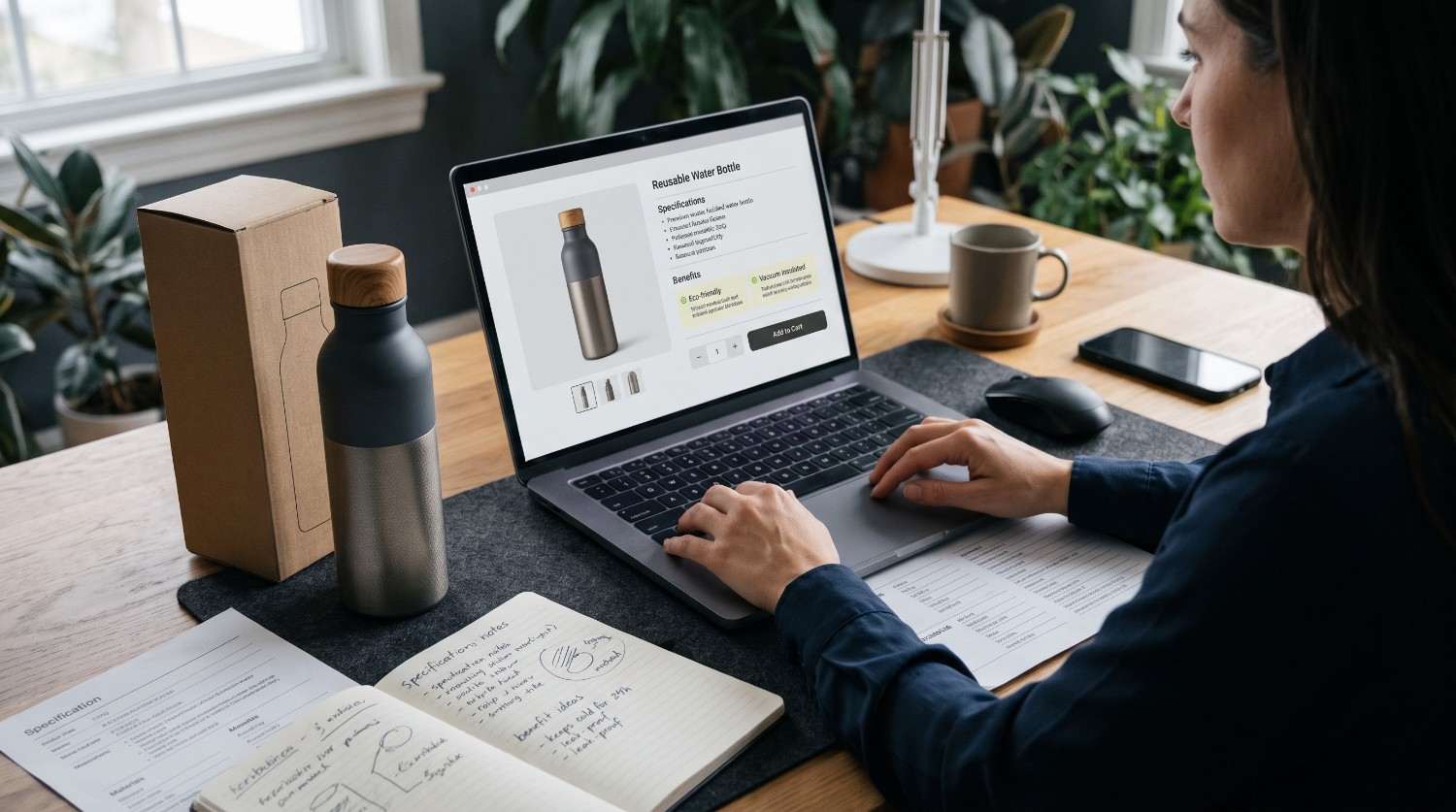
A product page has one job: answer the buyer's last few questions before they decide. Product description writing is where most of those answers live, yet many stores paste in manufacturer text or write a paragraph of adjectives and move on. In Baymard Institute's usability testing, every participant relied on the product description at some point to judge whether an item suited them.
The short version of best practice: open with what the product is and who it is for, put specifications and sizing in a scannable format, write about one reader, keep every claim verifiable, and make the same facts available to Google and AI shopping tools. Some Baymard studies cited here date from the late 2010s, so treat those figures as directional. Platform rules were checked on October 30, 2026.
What Makes a Good Product Description? Quick Answer
Definition: A product description is the text on a product page that tells a shopper what an item is, who it is for, how it works and what to expect, so they can decide without handling it. Good ones combine clear benefits with accurate specifications, and they match the product's feed and structured data.
A good product description opens with what the product is and who it is for, explains two or three benefits in plain language, lists specifications and sizing in a scannable format, answers likely objections, and stays accurate to the product, so shoppers can decide and search systems can read it.
Element | What to include | Why it matters |
Opening line | What it is and who it is for | Lets skimmers decide in seconds |
Benefits | Two or three, specific and plain | Turns features into reasons to buy |
Specs and sizing | Dimensions, materials, compatibility, what is in the box | Prevents surprises after purchase |
Proof and reassurance | Verifiable details, warranty, review highlights | Builds trust without hype |
Answers to doubts | Care, fit, shipping, returns pointers | Removes reasons to leave the page |
Search and feed fit | Natural keywords, the same facts as your feed | Supports visibility in Google and AI shopping |
One mistake people often make is treating the description as decoration. Baymard's benchmark found that about 10% of large ecommerce sites had descriptions too thin for shoppers' needs, which is why detailed copy remains the industry standard.
Research Your Reader Before You Write
The best product descriptions are built from real customer questions, not from the manufacturer's spec sheet. Collect the questions shoppers actually ask, write for one specific buyer, and answer the doubts that stop them from ordering.
Source | What it reveals | How to use it |
Customer reviews | The words buyers use and what they praise or dislike | Borrow phrasing and address recurring complaints |
Support tickets and live chat | Questions the page failed to answer | Add those answers to the description or FAQ |
Return reasons | Where the page set the wrong expectation | Fix size, color, or capability wording |
Search queries and Search Console | How people describe the product | Use natural variations in headings and copy |
Competitor pages and Q&A | What buyers expect to see | Match the basics, then add what they omit |
A useful exercise is to write the buyer's three biggest doubts at the top of a blank page before drafting. If the description does not answer them, it is not finished.
A common issue is writing for everyone. A description aimed at a specific buyer, such as someone replacing a worn-out daily bag, tends to be clearer than one trying to appeal to all possible customers.
How to Structure a Product Description for Scanning
Structure a product description so a shopper can skim it: a one-sentence opening, short benefit-led highlights, a clean list of specifications, and a few answers to common questions. Baymard's testing found shoppers respond well to long descriptions when they are chunked by feature highlights.
In Baymard's research from 2018, structuring descriptions by highlights, each with a supporting image, increased engagement, yet only 22% of sites did it. The same research found that spec sheets longer than about 20 items need grouping into titled sections so shoppers can find what they need.
A reliable template:
Opening sentence. Name the product, who it is for and the main reason to buy it.
Three highlights. Each starts with a benefit, followed by the feature that delivers it.
Specifications. Use a list or table, grouped when it runs long.
What is in the box and care instructions. Answer the basics.
Short FAQ or Q&A. Baymard's research found FAQs and customer Q&A complement the description without making it long.
Keep paragraphs to two or three sentences and test the page on a phone, where long blocks become hard to read. As a planning guide, simple products often need roughly 80 to 150 words and complex ones 150 to 300 plus a spec table, but let the buyer's questions set the length rather than a word count.
Images and text work together. Baymard found 56% of testers explored images first, yet descriptions still carry details images cannot show, such as materials, scale and compatibility.
Features, Benefits and Proof: How to Write Copy That Persuades
Persuasive product copy connects each feature to a benefit and backs it with a verifiable detail. A feature says what the product has, a benefit says what that means for the buyer, and proof gives them a reason to believe it.
Feature | Benefit | Proof (use only if true) |
Double-wall insulation | Keeps drinks cold through a workday | [Tested hours or test method] |
Water-resistant outer fabric | Handles light rain on the commute | [Rating or test standard] |
Adjustable shoulder strap | Fits different heights comfortably | [Strap length range] |
Illustrative structure. Replace the bracketed items with facts from your product testing or supplier documentation.
Hypothetical before and after: "Our premium bottle is perfect for everyone" becomes "A 750 ml steel bottle that fits most car cup holders and keeps drinks cold through a workday [add tested hours]." The second version names the size, a use and a result, and leaves a clear spot for proof.
Baymard's research also recommends in-scale phrasing, such as "fits in the palm of your hand," because shoppers struggle to judge size from photos. Vague superlatives like best, perfect or premium add little. Specific, checkable language builds trust.
One mistake people often make is promising what the product cannot deliver. Overstated claims tend to create 'not as described' returns and bad reviews, so write what you can stand behind.
Specifications, Sizing and Details That Prevent Returns
Product specifications should answer the questions that cause returns: size, material, compatibility, what is included and how to care for the item. Include them in plain, structured form, with units and exact values.
Category | Details to include |
Fashion and footwear | Size chart, fit notes, model height and size worn, fabric composition, care |
Electronics | Compatibility, ports, power, dimensions, what is in the box, warranty |
Home and furniture | Exact dimensions, weight, materials, assembly needs, care |
Beauty and personal care | Ingredients, skin or hair type, usage, size or volume |
Food and supplements | Ingredients, allergens, serving size, storage, regulatory wording |
Baymard's research recommends making clear which accessories are included and which are optional extras. Use the same product facts across variants, so a color or size change does not silently change the description.
Regulated categories need extra care. Health, safety and nutrition claims may be restricted in your market, so confirm what you are allowed to say before publishing.
SEO for Product Descriptions: Keywords, Titles and Duplicate Content
For product page SEO, write a unique description that uses the main keyword naturally in the title and early copy, covers variations shoppers use, and describes what makes the product distinct. Google's John Mueller has said duplicate manufacturer descriptions are not demoted, but unique text helps pages stand out.
The point matters most for resellers. Many stores publish identical manufacturer copy, so nothing separates one page from another. Mueller has also said descriptions of what makes similar products look different help Google rank them.
Issue | Risk | Fix |
Manufacturer copy used as is | Nothing distinguishes your page from other sellers | Add unique details, use cases and FAQs |
Near-identical variant pages | Search engines struggle to tell pages apart | Describe real differences in color, size or fit |
Keyword stuffing | Reads badly and adds no value | Use the main phrase once or twice, naturally |
Same text on category and product pages | Blurs which page should rank | Write distinct category copy |
Missing or copied meta descriptions | Weak search snippets | Write a short, specific one per product |
Use Product structured data that matches the visible page, including name, image and description, so search engines can read the details. A single product description should work for people first, with search in mind second.
Writing Product Descriptions for Google Shopping and AI Shopping Tools
For Google Shopping, Merchant Center accepts descriptions up to 5,000 characters, but recommends around 500 to 1,000 characters, with the most important details in the first 160 to 500. Descriptions must be plain text that matches the landing page, without promotional text.
According to Google's Merchant Center documentation, descriptions should list features, technical specifications and visual attributes, follow standard grammar, and end with punctuation. Google's editorial rules say not to include promotional phrases such as free shipping, block capitals, or a description of your brand. Titles can run to 150 characters.
Channel | Limit or rule | Writing implication |
Google Merchant Center | Description up to 5,000 characters; 500 to 1,000 recommended | Put size, material and key features first |
Google Merchant Center titles | Up to 150 characters | Lead with what the product is |
ChatGPT product feeds | Title 150 and description 5,000 characters, per secondary summaries | Reuse the same clean copy |
Google AI Overviews and AI Mode | No special structured data required, per Google as summarized by Hypotenuse | Keep feed and page data accurate and consistent |
AI shopping tools work from structured product data, so facts matter more than flourish. Fill in attributes such as size, color, material and compatibility, and keep them consistent with the page. Merchant Center also has optional question-and-answer attributes that can help products appear in conversational surfaces.
A common issue is putting marketing language into the feed. The feed should hold factual, matchable details, while the page can carry the story.
Writing Product Descriptions at Scale: Templates, AI and Quality Control
At scale, write descriptions from a fact sheet per product and a template per category, then add the details that make each product distinct. AI can draft copy faster, but a person should verify every specification and claim before publishing.
Create a fact sheet for each product with specs, materials, dimensions and approved claims.
Write a template per category with the opening, highlights and spec order.
Draft with the facts supplied. If using AI, give it only the verified fact sheet.
Fact-check. Compare every number and claim with the supplier or your testing.
Check uniqueness. Make sure similar products do not share near-identical text.
Label correctly. Google's Merchant Center says descriptions created with generative AI should use the structured description attribute, rather than the standard description attribute.
Review on a schedule. Update when specifications, stock or policies change.
Task | AI can help | Human must check |
First draft from a fact sheet | Yes | Tone and accuracy |
Variant wording | Yes | That differences are real |
Specifications and claims | No, supply them | Every value and unit |
Regulated claims | No | Legal and compliance review |
The main risk is invented detail. AI may add a feature or number that sounds plausible but is false, which can cause returns and policy problems.
Common Product Description Mistakes
The most common product description mistakes are copying manufacturer text, listing features without benefits, hiding key specs, using vague superlatives, and letting the feed and page disagree. Each is easy to fix once spotted.
Mistake | Why it hurts | Fix |
Copying manufacturer text | Nothing sets your page apart | Add original details and use cases |
Features without benefits | Shoppers must work out the value | Connect each feature to a result |
Wall of text | Hard to scan, especially on mobile | Use highlights, bullets and short paragraphs |
Missing size or compatibility | Drives questions and returns | Put them near the top |
Vague superlatives | Adds no information | Use specific, checkable facts |
Feed and page disagree | Can cause disapprovals and confusion | Keep one source of truth |
Never updating | Stale details mislead buyers | Review on a schedule |
How to Test and Improve Your Product Descriptions
Improve product descriptions by prioritizing top sellers and high-return items, changing one thing at a time, and judging results over a fair period. Track conversion rate, add-to-cart rate, return reasons and the questions shoppers still ask.
Signal | What to track | What it suggests |
Conversion and add-to-cart rate | Page performance by product | Whether the copy persuades |
Return reasons | Share tagged 'not as described' or size | Whether the copy sets the right expectation |
Support questions | Repeated questions about one product | Details missing from the page |
Search Console | Impressions and clicks by page | Whether titles and copy match searches |
Merchant Center diagnostics | Disapprovals and warnings | Feed or description issues |
Start with a handful of high-traffic products rather than rewriting the whole catalog. If you run A/B tests, change one element at a time and run them long enough to reach a trustworthy sample, since small stores often lack the traffic for quick results. When traffic is low, compare before-and-after periods and watch return and support data alongside sales.
Conclusion: Write for the Buyer, Then Make It Machine-Readable
Product description writing works when it answers real questions in a form people and systems can read. Three points matter most:
Build each description from real customer questions, and open with what the product is and who it is for.
Put specifications and sizing in a scannable format, and keep every claim verifiable.
Keep your page, feed, and structured data consistent, and have a person check anything AI drafts.
Your next step is to pick your ten best-selling or highest-return products, list the questions shoppers ask about each, and rewrite those descriptions first. Then compare conversion, returns, and support questions after a few weeks.