
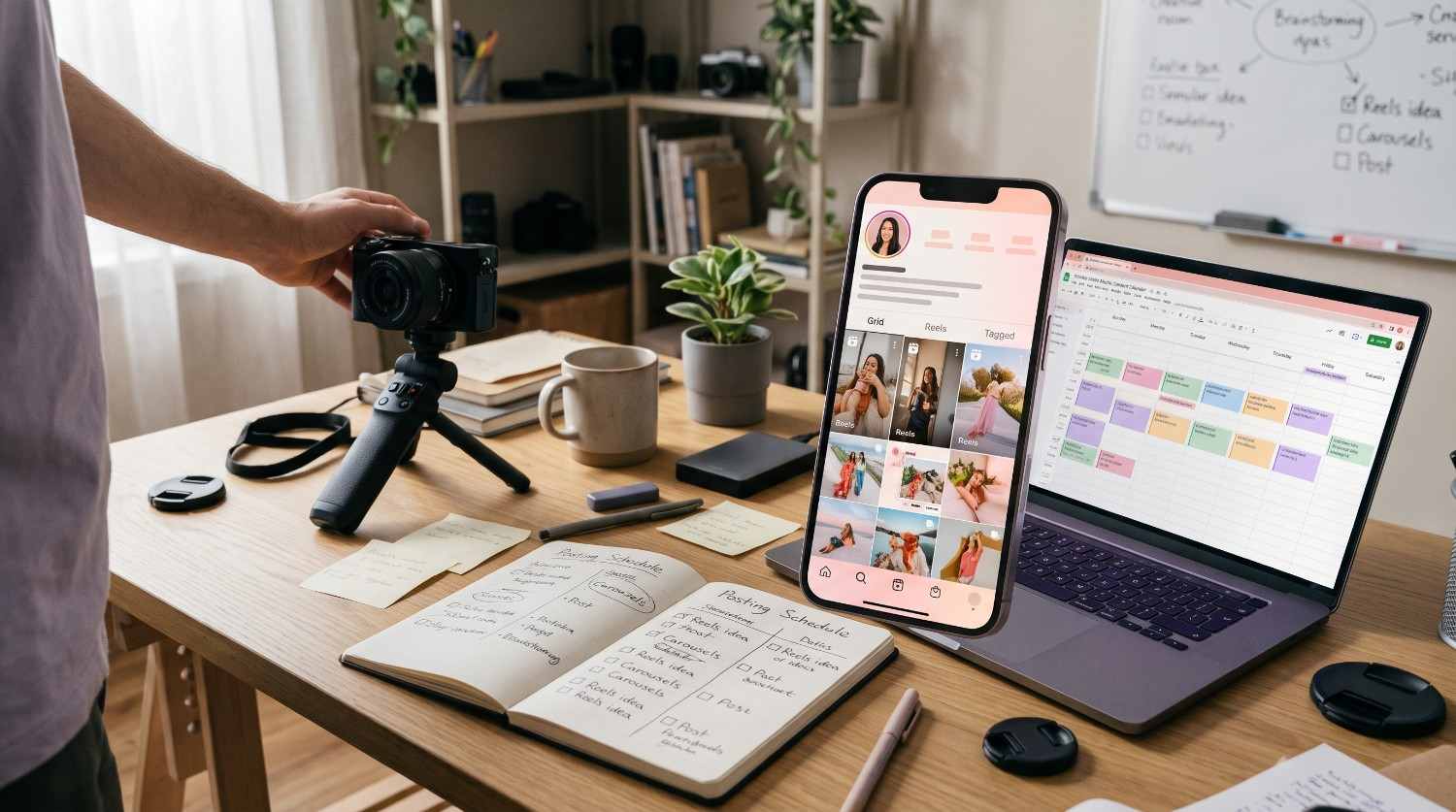
Posting more often usually helps on Instagram, but only up to a point, and only if quality holds. So how often should you post on Instagram? For most accounts, the best-supported answer is 3 to 5 feed posts a week, plus Stories on most days. The right number still shifts with your goal, your format mix, and your team's capacity.
This guide compares the main studies, explains why they disagree, and shows how to find your own rhythm. It comes from Framecipher, a Dhaka-based digital marketing agency that works with Meta ad campaigns, which include Instagram, and every range here is a starting point to test, not a rule.
How Often Should You Post on Instagram? The Short Answer
Most Instagram accounts should post 3 to 5 feed posts or Reels per week and share Stories on most days. Buffer's analysis of 2.1 million posts found that 3 to 5 weekly posts more than doubled follower growth rate compared with 1 to 2. Instagram's own guidance is lighter: about two feed posts a week.
Instagram has no required posting frequency, as far as its public guidance shows. In a Q&A on Instagram's @creators account, head of Instagram Adam Mosseri advised about a couple of feed posts per week and a couple of Stories per day, as reported by Social Media Examiner. The data-driven numbers are higher, and the reason is covered by what each study measures.
In short:
Minimum to stay active: 1 to 2 feed posts or Reels per week. Buffer reports that posting less than this could mean stagnation or even lost followers.
Sustainable growth: 3 to 5 per week, which is where Buffer found the biggest step up.
Maximum growth: 6 to 9 or more per week, with diminishing returns and a real risk to quality.
Stories: a couple per day, which matches Instagram's own suggestion.
Format | Starting frequency | Main job |
Feed posts and Reels combined | 3 to 5 per week | Reach and follower growth |
Reels (within that total) | 1 to 3 per week | Reaching people beyond current followers |
Stories | A couple per day, up to 4 to 5 | Keeping current followers engaged |
Minimum for any account | 1 to 2 per week | Staying active |
Definition: Instagram posting frequency is the number of feed posts, Reels, and Stories an account publishes in a given week or day, and the rhythm at which it publishes them. A consistent rhythm matters as much as the total, because gaps between posts affect growth.
A better way to think about it is this: the number is a starting point, and the rhythm you can sustain for months is what decides the result.
What the Data Says About Instagram Posting Frequency
Studies disagree on the ideal Instagram posting frequency because they measure different outcomes. Buffer finds that reach and follower growth keep rising with more posts, while Dash Social finds that engagement rate peaks at 2 to 3 feed posts per week. Both can be true at the same time.
Source | Sample | Metric | Finding |
Buffer (August 2025) | 2.1 million feed posts from 102,000 accounts; Stories excluded | Reach per post and follower growth rate | 3 to 5 posts a week gave about 12% more reach per post and more than double the follower growth rate versus 1 to 2; 10 or more gave about 24% more reach per post |
Dash Social (August 2026) | More than 3.3 million posts, Reels, and Stories from over 3,000 brands, July 2025 to June 2026 | Engagement rate (completion rate for Stories) | 2 to 3 feed posts a week had the highest engagement rate |
ZoomSphere Frequency Formula report | Brand accounts, per the report | Engagement rate and reach | Instagram engagement rate peaked at one or two posts a week, while more posting increased visibility |
Instagram guidance (Adam Mosseri) | Not a study | Recommendation | About a couple of feed posts a week and a couple of Stories a day |
The difference is the metric. Engagement rate is a per-post average, so it can fall as an account publishes more, even while total reach and follower growth rise. A brand can reach its best engagement rate at two posts a week and still reach more people overall at five.
Each source also has a limit. Buffer's data comes from accounts that use Buffer, and Dash Social's comes from brands that pay for its platform, so both describe accounts with some planning in place. Buffer also notes that the raw link between posting and growth may not tell the full story, since fast-growing accounts may naturally post more. To address this, it compared each account against its own baseline, and weeks with no posts fell below that baseline.
Buffer offers a simple illustration for a 5,000-follower account: roughly 6 extra followers a week at 1 to 2 posts, 13 at 3 to 5, 22 at 6 to 9, and 33 at 10 or more, compared with not posting at all. That is Buffer's illustration, not a forecast, but it shows the diminishing returns clearly.
How Often to Post on Instagram by Format: Feed, Reels, and Stories
Instagram accounts typically post feed posts and Reels 3 to 5 times per week combined, Reels 1 to 3 times per week, and Stories a couple of times per day. Feed posts and Reels reach new people, while Stories mainly serve existing followers, so each format has a different job and frequency.
Format | Main audience | Suggested starting frequency | Evidence |
Feed posts (photos, carousels) | New and existing people | 2 to 5 per week | Dash Social: 2 to 3 for engagement rate; Buffer: 3 to 5 for reach and growth |
Reels | New and existing people | 1 to 3 per week | Dash Social: 1 to 3 Reels a week had the highest engagement on video |
Stories | Existing followers | A couple per day, up to 4 to 5 | Mosseri: a couple a day; Dash Social: 30 or more frames a week had the highest completion rates |
Stories work differently from feed posts. According to Dash Social, they are designed to connect with existing followers, not attract new ones, so their job is retention and familiarity. Each frame in a Story sequence counts as a separate Story, which means 30 frames a week can be six short sequences of five frames.
One mistake people often make is treating Stories like feed posts and sharing one a day. A few short sequences across the day match how the format is used.
Buffer's study included photos, Reels, and carousels together and did not separate formats, so the split by format is guidance, not something that dataset proves. Dash Social's industry averages show how much it varies: beauty brands average 5 feed posts, 16 Stories, and 3 Reels a week, while real estate brands average 5 feed posts, 1 Story, and 2 Reels. Those are averages for brands on one platform, not targets.
How Often Should a Business Post on Instagram? Cadence by Goal and Account Type
A business should match its Instagram posting frequency to its goal and capacity: 1 to 2 posts per week to stay active, 3 to 5 for sustainable growth, and 6 or more only when quality can hold. Smaller teams typically do better with a lower, steady cadence than an ambitious one they cannot keep up.
The cadences below are starting hypotheses, not benchmarks.
Goal or account type | Starting cadence | Why | What to watch |
Staying active with limited time | 1 to 2 feed posts or Reels per week, plus a few Stories | Buffer's minimum | Gaps longer than a week |
Sustainable growth (most small businesses) | 3 to 5 per week, plus Stories most days | Buffer's sweet spot for reach and growth | Quality slipping to hit the number |
Best per-post engagement (brand accounts) | 2 to 3 feed posts per week | Dash Social's engagement-rate finding | Lower total reach than a higher cadence |
Maximum growth (creators, dedicated teams) | 6 to 9 or more per week | Buffer: more reach and growth, with diminishing returns | Burnout and thin quality |
New account, first 90 days | About 3 per week, held steady | Enough volume to learn from, and sustainable | Starting too high and stopping |
Ecommerce or local business | 3 to 5 per week, mixing product, proof, and behind-the-scenes | Fits the sustainable-growth range | Posting only promotions |
A smaller account does not need a larger account's schedule. Dash Social's industry table shows media brands averaging 32 feed posts a week, but that reflects teams and news cycles, not a target for a small business.
Why Quality and Consistency Matter More Than the Number
Content quality and consistency matter more than the exact posting number on Instagram because ranking depends on how viewers respond. Adam Mosseri has named watch time, likes per reach, and sends per reach as the top ranking signals, so posts that earn those signals outperform extra posts that do not.
Mosseri said in January 2025 that the top three ranking signals are watch time, likes, and sends, and advised creators to check average watch time, likes per reach, and sends per reach in their Insights, as reported by Social Media Today. None of these signals rewards volume on its own.
Consistency still matters. Buffer calls it the “no-post penalty”: weeks with no posts had follower growth about 0.08 standard deviations below an account's own typical growth. Even 1 to 2 posts a week was a significant improvement over no posts.
Buffer's own conclusion is that content quality is probably the most important factor, and that high volume can force quality down or lead to burnout, which can hurt growth more than a measured pace.
This typically happens when an account sets a target like 10 posts a week, runs out of ideas by week three, fills the gaps with low-effort posts, and then stops altogether. A steady 3 posts a week usually beats a burst of 10 followed by weeks of silence.
How to Find Your Own Posting Frequency
To find the best Instagram posting frequency for an account, change one variable at a time over four-week blocks, such as 3 posts a week followed by 5, and compare reach per post, sends per reach, average watch time, and follower growth in Instagram Insights. Keep format, topics, and timing steady so cadence is the only difference.
This four-week method is a suggested approach, not an Instagram requirement.
Set a baseline. Record the last four weeks: posts per week, reach per post, follower growth, and average watch time for Reels.
Choose one change. For example, move from 3 to 5 posts a week, or add one Reel.
Hold everything else steady. Keep the same topics, formats, and posting times where possible.
Run it for four weeks. One or two weeks is too short, because single posts can swing results.
Compare against the baseline. Look at reach per post and sends per reach first, then follower growth.
Keep, revert, or test again. If quality dropped or the team struggled, revert.
Metric | What it tells you | Where to find it |
Reach per post | How many people each post reaches | Instagram Insights |
Sends per reach | Whether people share posts by message | Insights, divided by reach |
Average watch time | How well Reels hold attention | Insights, per Reel |
Follower growth | Whether the cadence is adding audience | Insights, week over week |
If the audience spans time zones, such as the US alongside the UAE or Bangladesh, use Insights' most-active times for your audience, not your own local time, when comparing blocks.
Sample Weekly Posting Schedules
A sustainable Instagram schedule for most accounts is three to five feed posts a week, such as two Reels and one to two carousels, plus Stories on most days. Creating content in one weekly batch and scheduling it in advance keeps the cadence steady without daily pressure.
These are templates, not rules.
Schedule | Feed posts and Reels | Stories | Best for |
Minimum | 1 to 2 per week (for example one Reel and one carousel) | A few short sequences a week | Limited time, staying visible |
Sustainable | 3 to 5 per week (for example Mon Reel, Wed carousel, Fri Reel, Sun photo) | A couple a day | Most small businesses and creators |
Growth | 6 to 9 per week (for example 3 Reels, 2 carousels, 1 to 4 photos or quotes) | Several short sequences daily | Dedicated teams and full-time creators |
Dash Social suggests rotating formats week to week. For a three-post week, that could be 2 Reels and 1 carousel one week, 1 Reel and 2 static posts the next, and 1 static post, 1 carousel, and 1 Reel the week after. Rotating keeps the feed varied and shows which formats your audience responds to.
In practice, batching is what makes a schedule last. Planning the week's posts in one sitting and scheduling them removes the daily decision, and daily decisions are where cadences usually break.
Posting Too Much or Too Little: Warning Signs and Fixes
Falling reach per post and creative burnout signal posting too much, while empty weeks and flat growth signal posting too little. The fix for too much is usually dropping a tier and improving the posts that remain, and the fix for too little is a schedule short enough to keep.
Sign | Likely cause | Fix |
Reach per post falling as volume rises | Quality or topics are thinning out | Drop back one tier and improve hooks and ideas |
Several weeks with no posts | The cadence is more ambitious than the team's capacity | Lower the target and schedule a week ahead |
Engagement rate falling while total interactions hold or rise | An averaging effect at higher volume | Judge by total reach and follower growth as well |
Low Story completion | Too many low-value frames, or no clear sequence | Group frames into short sequences with a point |
Team burnout | An unsustainable weekly volume | Batch creation and repurpose top posts |
One mistake people often make is assuming the fix for flat reach is always more posts. If an account posts steadily and reach is still flat, the issue is usually the content itself, such as weak opening seconds or posts people don't send to others.
When strong posts already perform, but organic reach plateaus, paid promotion through Meta Ads management can extend them to people who do not yet follow the account. That works best for posts that already earn watch time and sends, and it is a separate decision from how often to post.
Conclusion
Three points carry the answer:
Start at 3 feed posts or Reels a week plus Stories on most days, and move toward 5 only if quality holds.
Never go dark: even 1 to 2 posts a week beats empty weeks.
Test one cadence change at a time over four weeks, and judge by reach, sends, and follower growth.
The next step is to pick a cadence, schedule one week in advance, and review Instagram Insights after four weeks. If your best posts already perform and you want them to reach more people, Framecipher's Social Media Management Service covers Meta campaign planning and management.