
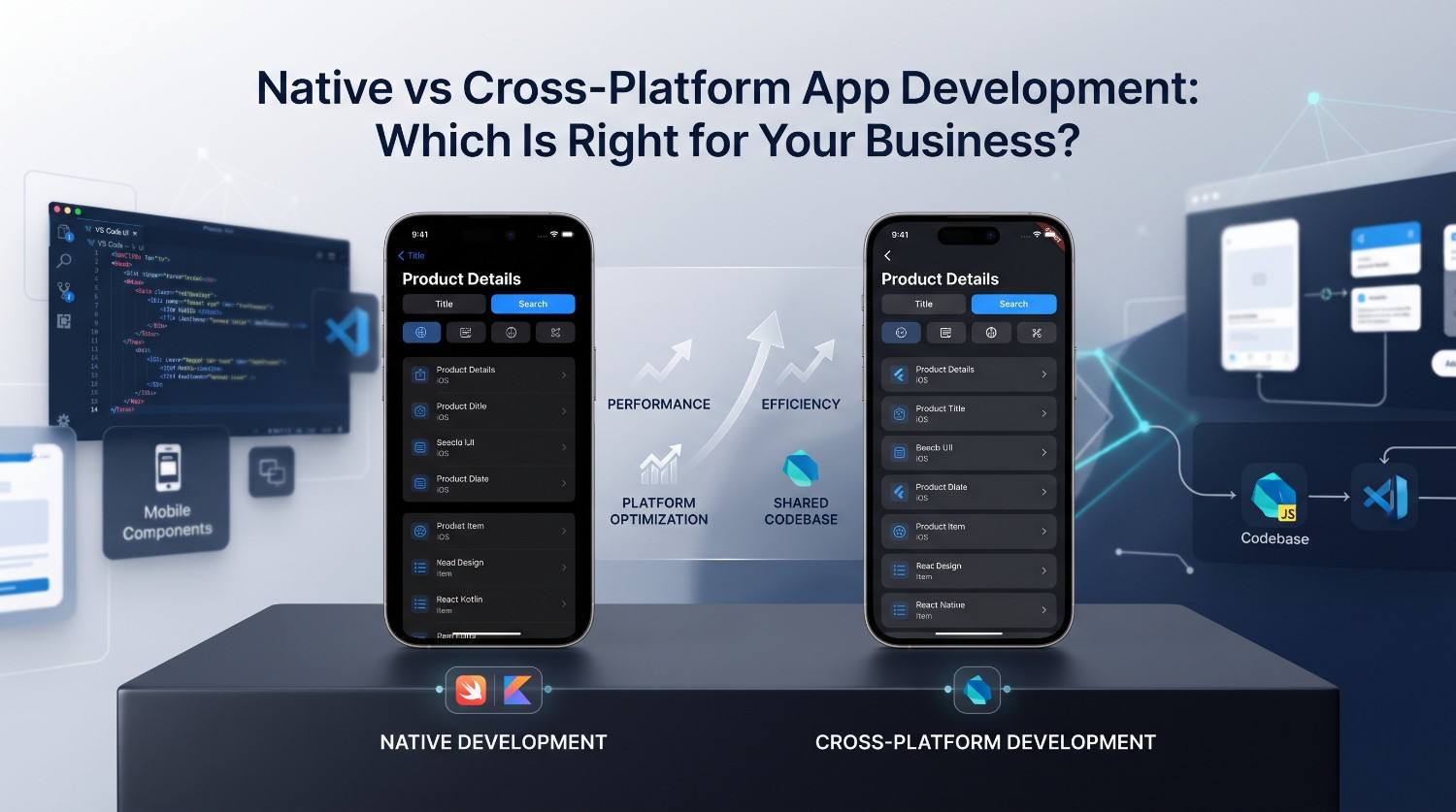
Picking the wrong development approach for a mobile app either means overspending on performance a business app never needed, or hitting a real performance wall in a build that genuinely needed more. Native vs cross-platform app development isn't just a technical decision handed off to a developer; it directly shapes cost, timeline, and how the app actually performs once real users are on it.
Quick Answer: Native or Cross-Platform?
Native app development typically fits apps that need maximum performance or deep platform-specific features, such as games, AR/VR apps, or apps using advanced hardware. Cross-platform development typically fits standard business apps that need both iOS and Android on a tighter budget and timeline, since a single shared codebase covers both platforms at once.
Cross-platform builds are generally cheaper and faster to develop initially, while native builds typically cost more upfront and to maintain, since separate iOS and Android codebases mean essentially building and later updating the app twice.
How Each Approach Actually Works
 Separate native app codebases compared with a shared cross-platform codebase
The core difference between native and cross-platform development comes down to one decision: separate codebases versus a shared one. Every downstream difference in cost, performance, and maintenance flows from that single choice.
Native vs Cross-Platform App Development: Native app development builds separate applications for iOS and Android using each platform's own language and tools (Swift for iOS, Kotlin for Android). Cross-platform development uses a single shared codebase, such as React Native or Flutter to build both apps at once.
Native development builds two distinct applications, one for iOS using Swift and Xcode, one for Android using Kotlin and Android Studio. Because each app is written specifically for its platform, native development gets full access to platform-specific APIs and hardware features, which is what makes it capable of maximum performance. The tradeoff is cost: two separate codebases mean two development efforts, and later, two sets of updates every time a change is needed.
Cross-platform development uses a single shared codebase, most commonly React Native or Flutter, that compiles into apps for both iOS and Android. This is what makes cross-platform development faster and generally cheaper to build, since one codebase serves both platforms instead of two. The tradeoff shows up in graphics-heavy or hardware-intensive tasks, where a shared codebase can't always match native's direct access to platform-specific performance optimizations.
One mistake people often make here is assuming cross-platform always means a noticeably worse app. For most standard business apps, content browsing, forms, and basic navigation, the performance difference is not something typical users would notice in practice.
Native vs Cross-Platform App Development at a Glance
 Comparison of native and cross-platform app development costs, performance, and maintenance
Comparing the two side by side makes the tradeoff concrete, since most of the practical differences trace back to the shared-versus-separate codebase split.
What's the cost difference between native and cross-platform development? Cross-platform is typically cheaper upfront due to a single shared codebase, while native typically costs more both to build and maintain due to separate iOS and Android codebases requiring parallel development effort.
When Cross-Platform's Performance Trade-off Actually Matters
 Standard business apps compared with graphics-intensive and hardware-intensive mobile apps
 Cross-platform's performance limitation isn't a universal rule; it matters significantly for some app types and is effectively irrelevant for others.
Cross-platform performance is typically a non-issue for:
Standard business or utility apps (forms, content browsing, basic navigation)
E-commerce apps with standard product browsing and checkout flows
Social or content apps without heavy real-time graphics
Apps primarily displaying data, lists, or standard UI components
Cross-platform performance genuinely matters for:
Mobile games, particularly those with complex graphics or physics
AR/VR apps requiring direct, low-level hardware access
Apps with heavy real-time animation or video processing
Apps that need the newest OS-level features immediately upon release, before cross-platform frameworks typically catch up
Does React Native perform as well as native apps? React Native and similar frameworks perform well for most standard business apps, but can show measurable performance limitations in graphics-heavy or hardware-intensive use cases, where true native development has a clear advantage.
Most articles treat "native is faster" as a blanket rule, but the practical difference only shows up in a specific category of apps. A restaurant ordering app or a service booking app is unlikely to feel the gap at all; a mobile game with complex physics almost certainly will.
Long-Term Maintenance Cost Differences
 Separate native app maintenance workflows compared with a shared cross-platform workflow
 The initial build cost is only part of the total cost comparison; maintaining the app after launch is where the gap between native and cross-platform often becomes most visible.
A native app means maintaining two separate codebases indefinitely. Every new feature, bug fix, or OS update requires work on both the iOS and Android versions separately, which roughly doubles the ongoing development effort compared to a single shared codebase.
A cross-platform app generally needs updates made once, applied to both platforms simultaneously, which keeps ongoing maintenance costs lower. The tradeoff is less direct control over platform-specific behavior, which can occasionally require workarounds when a feature needs to behave differently on iOS versus Android.
Native: Two codebases to test and release, more developer hours per update cycle, but full control over platform-specific behavior
Cross-platform: One codebase to test and release, fewer developer hours per update cycle, occasional workarounds needed for platform-specific edge cases
Can you switch from cross-platform to native later? Switching is possible but requires largely rebuilding the app for each platform separately, so it's rarely a simple migration; this is worth factoring into the initial decision rather than treating cross-platform as a risk-free starting point that can always be upgraded later without cost.
Which One Is Right for You? (Decision Framework)
Instead of defaulting to whichever approach is more talked about, weigh the decision against these five variables directly.
Budget: Tighter budget, need both platforms covered → cross-platform. Budget built for a performance-critical or platform-specific product → native.
Timeline: Need to launch on both iOS and Android quickly → cross-platform's single codebase moves faster. Timeline allows for building each platform separately → native becomes workable.
Performance needs: Standard business functionality (forms, browsing, checkout) → cross-platform handles this well. Graphics-heavy, hardware-intensive, or real-time performance needs → native is the safer choice.
Target platforms: Need both iOS and Android from day one on a shared budget → cross-platform's efficiency helps most here. Launching on a single platform first, or platform-specific features are core to the product → native may make more sense.
Long-term maintenance capacity: Limited in-house or agency development bandwidth for ongoing updates → cross-platform's single codebase is easier to sustain. Resources available to maintain two codebases long-term → native's maintenance overhead is more manageable.
Common Mistakes When Choosing an App Development Approach
The same handful of mistakes come up repeatedly across businesses evaluating native versus cross-platform.
Choosing native for a simple business app that didn't need it: Paying for two separate codebases and their ongoing maintenance when a standard app's performance needs would have been fully met by cross-platform.
Choosing cross-platform for a performance-intensive app: Building a game or AR app on a cross-platform framework and running into performance limits that require a costly rebuild in native later.
Not budgeting for long-term maintenance cost: Focusing only on the initial build price and being surprised later by how much more expensive ongoing updates are for two native codebases versus one shared codebase.
Assuming the decision is permanent and irreversible either way: Both approaches can technically be changed later, but switching, especially from cross-platform to native, usually means a substantial rebuild rather than a simple transition.
Conclusion
Native and cross-platform aren't a matter of one being universally better; the right choice depends on how performance-intensive the app actually is, and how much ongoing maintenance capacity is realistically available.
Long-term maintenance cost, not just the initial build price, often makes the bigger difference between the two approaches over time. Standard business apps rarely need native's performance advantages, while games, AR/VR, and hardware-intensive apps usually do.
If you have an app idea and aren't sure which approach fits, talk to our team; we'll help you match the right approach to what your app actually needs to do.